Gear, gerotor, vane, and piston — every hydraulic pump moves oil, but each design makes a different trade between cost, control, and capability. Here’s how to tell them apart, in plain language, with a look inside each one. And since most of these designs also run in reverse as motors, we’ll cover that side too.
Every pump trades between
cost, control, and capability
There’s no best pump — only the right pump for the job. As a rule, the four designs sit on a spectrum: on one end, simple and inexpensive; on the other, precise and powerful. Moving right buys you more pressure and more control, and it costs more to purchase and maintain. One more term before we start: a pump that moves the same amount of oil with every turn is called fixed displacement. A pump that can change how much it moves on the fly is variable displacement — that’s where most of the control (and cost) lives.
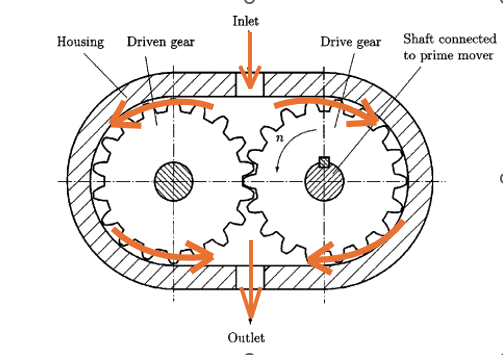
Two meshed gears spin inside a tight housing. Oil gets carried around the outside of the gears from inlet to outlet — never between them — as the cutaway shows. Fewer parts means less to go wrong and less to pay for, which is why gear pumps are the most common pump in mobile equipment.
The catch is that a gear pump only comes in fixed displacement. Every revolution moves the same amount of oil, so the only way to change flow is to change engine speed or dump the extra over a relief valve — which turns wasted power into heat.
Benefits
Lowest purchase price of the four
Rugged — shrugs off dirtier oil than most
Simple to repair or replace
Compact and light for its output
3-Way Diverter
Fixed flow only — no built-in control
Noisiest of the four designs
Efficiency drops as it wears
Wastes energy as heat in partial-load systems
Where You'll Find It
Log splitters, dump trucks, ag equipment, loaders, fan drives — and as low-cost gear motors on conveyors and augers.
Oil rides in the tooth pockets around the outside of both gears. One gear is driven by the engine or motor; the other simply follows.
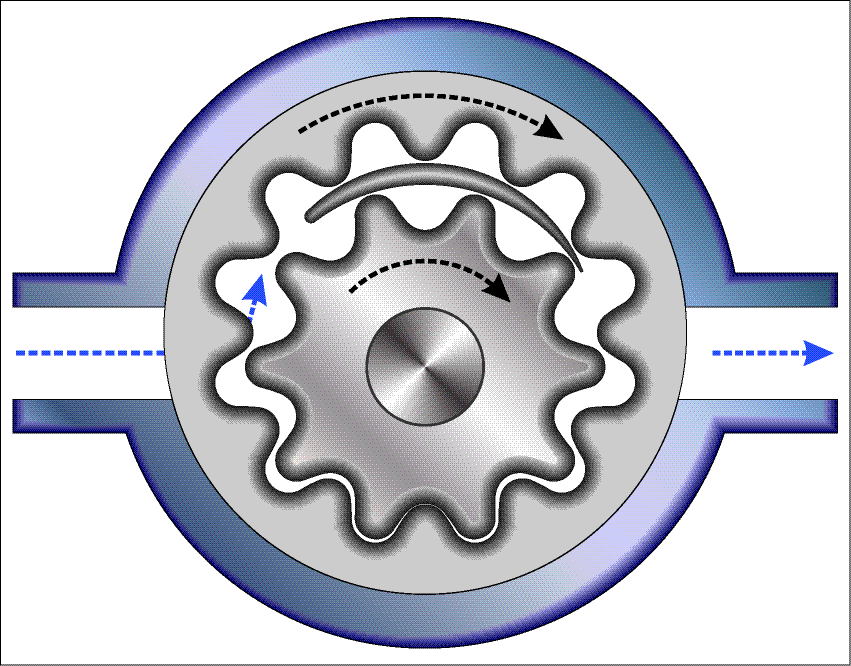
The inner rotor runs one tooth short of the outer ring. The pockets between them grow on the suction side and shrink on the discharge side — that's the whole pump.
Design 2 of 4
Gerotor Pumps
~2,000–2,500
PSI Typical Max
Fixed
Displacement
$
Relative Cost
Picture a gear turning inside another gear: an inner rotor with one less tooth than the outer ring it rides in. As the pair rotates, the pockets between the teeth grow on the suction side — drawing oil in — and shrink on the discharge side, pushing it out. The result is a very smooth, very quiet flow from a compact package.
Gerotors don’t chase high pressure — you’ll find them where steady, quiet flow matters more than muscle.
Benefits
Quietest, smoothest flow of the simple designs
Compact — fits where others won't
Inexpensive and long-lived at modest pressure
Limitations
Lowest pressure ceiling of the four
Fixed displacement only
Wear opens clearances and efficiency fades
Where You'll Find It
Charge pumps, engine oil pumps, lube circuits, low-pressure power units — and, as orbital motors, spinning wheel drives, sweeper brooms, and augers all over the job site.
Design 3 of 4
Vane Pumps
~2,500–3,000
PSI Typical Max
Fixed or Variable
Displacement
$$
Relative Cost
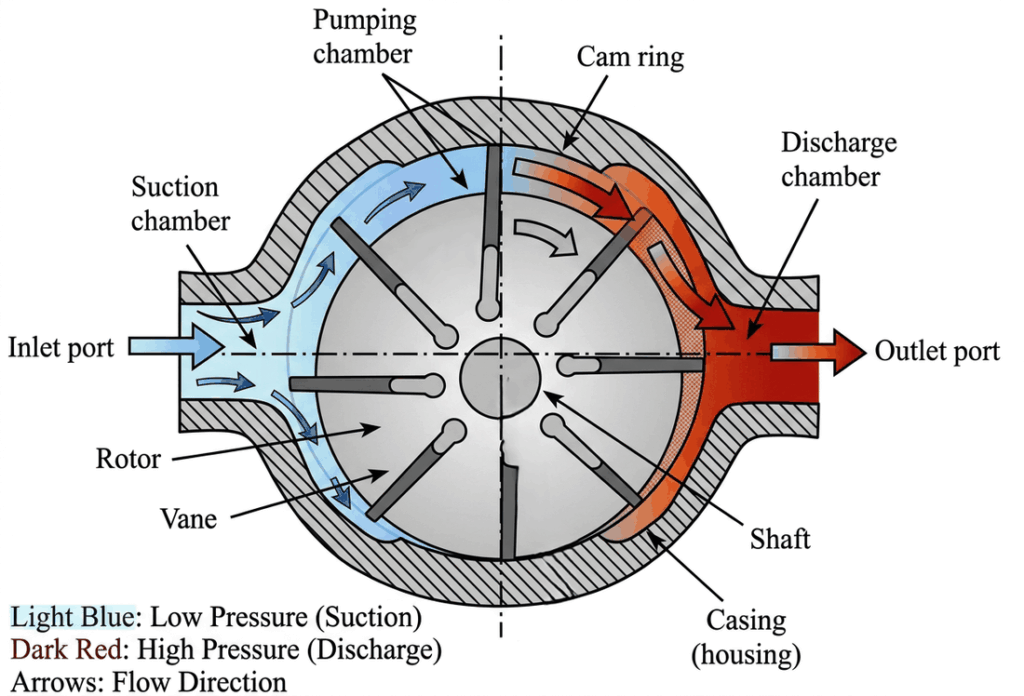
A slotted rotor spins inside an off-center cam ring, and flat vanes slide in and out of the slots to follow the ring — you can see in the cutaway how each pocket grows through the blue suction side and shrinks through the red discharge side. Because the vanes constantly adjust to the ring, a vane pump compensates for its own wear, and it runs noticeably quieter than a gear pump.
Vane pumps are also the least expensive way into variable displacement: a pressure-compensated vane pump automatically backs off its own flow when the system reaches pressure, saving energy and heat.
Benefits
Quiet, smooth, low-pulsation flow
Variable displacement available at moderate cost
Vanes self-compensate for wear; cartridge kits make rebuilds easy
3-Way Diverter
Pressure ceiling below piston designs
More sensitive to dirty oil than a gear pump
Vanes need pressure to seal — poor at very low speed
Where You'll Find It
Machine tools, injection molding, presses, and industrial power units — anywhere indoors where quiet matters.
Blue is suction, red is discharge. The rotor sits off-center in the cam ring, so each vane-to-vane pocket grows on the way in and shrinks on the way out.
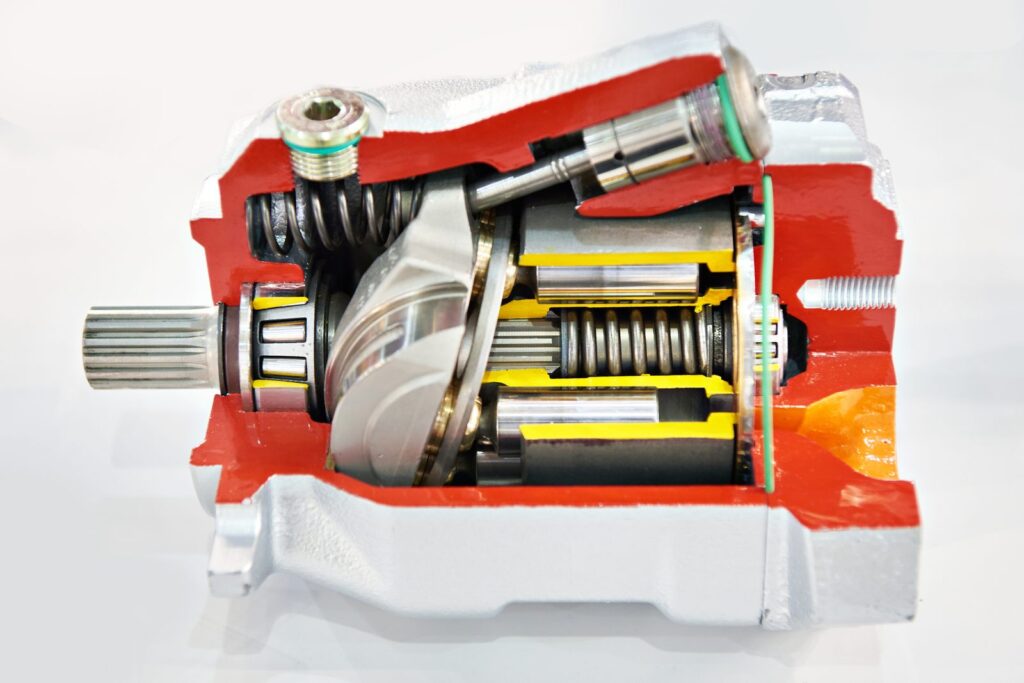
An axial piston pump cut open. The pistons ride against the tilted plate behind the input shaft — change the tilt, and you change how far each piston strokes.
Design 4 of 4
Piston Pumps
5,000–6,000+
PSI Typical Max
Fixed or Variable
Displacement
$$$$
Relative Cost
A ring of small pistons strokes in and out of a rotating barrel, riding on a tilted plate — you can see the angled plate and the pistons lined up behind it in the cutaway. Tilt the plate more and each piston strokes farther, moving more oil; tilt it flat and flow drops to nearly nothing while the shaft keeps turning. That tilting plate is the key to everything a piston pump can do.
It means the pump can be told exactly how much oil to deliver, moment to moment: hold a set pressure, respond to load-sensing signals, limit engine torque, even reverse flow in closed-loop drives. You pay for it — in purchase price, in sensitivity to contamination, and in repair complexity — but nothing else matches the combination of pressure, efficiency, and control.
Least tolerant of dirty oil — filtration is critical
More complex to diagnose and rebuild
Where You'll Find It
Excavators, cranes, high-pressure presses, and hydrostatic transmissions — and as piston motors on winches and travel drives.
Side by Side
The four designs
at a glance
Typical figures for common industrial and mobile units — individual models vary, so treat these as honest ballparks rather than catalog specs.
Spec
Gear
Gerotor
Vane
Piston
Typical Max Pressure
3,000–4,000 psi
2,000–2,500 psi
2,500–3,000 psi
5,000–6,000+ psi
Displacement
Fixed only
Fixed only
Fixed or variable
Fixed or variable
Flow Character
Some pulsation
Very smooth
Smooth, low pulsation
Smooth at pressure
Relative Cost
$
$
$$
$$$$
Noise
Loudest
Quiet
Quiet
Moderate
Dirt Tolerance
Best
Good
Fair
Least — clean oil is critical
Typical Efficiency
80–90%
75–85%
85–90%
90–95%
Typical Applications
Log splitters, dump trucks, ag equipment, loaders
Charge pumps, lube circuits, low-pressure power units
Machine tools, injection molding, industrial power units
Excavators, cranes, presses, hydrostatic drives
As a Motor
Fan drives, conveyors
Orbital motors — wheel drives, augers, brooms
Smooth industrial rotation
Winches, travel drives, hydrostatic loops
Rule of thumb: match the pump to the job, not the spec sheet. A piston pump on a log splitter is wasted money; a gear pump on an excavator is wasted fuel.
Not Sure What’s On Your Machine?
Bring us the pump — or just the question.
We sell, repair, and rebuild all four designs, and we’ll give you a straight answer on whether yours is worth fixing. If you’re specing a new system, we’ll help you land on the right pump the first time.